Quick start
using ModularityKit.Mutator.Abstractions.Core;
using ModularityKit.Mutator.Abstractions.Requests;
using ModularityKit.Mutator.Governance.Abstractions.Storage;
using ModularityKit.Mutator.Governance.Runtime.Storage;

var store = new InMemoryMutationRequestStore();

var request = MutationRequestFactory.PendingApproval(
    stateId: "tenant-42:roles",
    stateType: "IamRoleState",
    mutationType: "GrantRoleMutation",
    intent: new MutationIntent
    {
        OperationName = "GrantRole",
        Category = "Security",
        Description = "Grant elevated role to tenant operator"
    },
    context: MutationContext.User("requester-1", "Requester One", "Incident escalation"),
    expectedStateVersion: "v10",
    approvalRequirements:
    [
        MutationApprovalRequirement.SingleActorStep("security-lead"),
        MutationApprovalRequirement.SingleActorStep("platform-owner")
    ]);

var persisted = await store.Create(request);
Console.WriteLine($"{persisted.RequestId} -> {persisted.Lifecycle.Status}");
Primary APIs
Requests
MutationRequestMutationRequestFactoryMutationRequestDecisionMutationRequestStatusPendingMutationReason
The request factory also has generic overloads such as Approved<TState, TMutation>() and
PendingApproval<TState, TMutation>() when you already have concrete CLR types and do not want
to repeat stateType / mutationType strings at the call site.
MutationRequestDecision also exposes category-specific helpers such as Lifecycle(...),
Approval(...), and VersionResolution(...) so you do not have to spell out the low-level
decision wrapper when the category is already known.
Storage
IMutationRequestStoreInMemoryMutationRequestStore
Lifecycle
IMutationRequestLifecycleManagerMutationRequestLifecycleManager
Approval
IMutationRequestApprovalWorkflowManagerMutationRequestApprovalWorkflowManagerMutationApprovalRequirement
Queries
IMutationRequestQueryStoreMutationRequestQueryMutationApprovalQueryMutationRequestDecisionQueryMutationApprovalViewMutationRequestDecisionView
Resolution
IMutationRequestVersionResolverIMutationRequestVersionResolutionManagerMutationRequestVersionResolutionMutationRequestVersionResolutionOutcomeVersionedRequestResolutionStrategy
Execution
IGovernanceExecutionManagerGovernanceExecutionManagerGovernedExecutionResult<TState>GovernedCompensationPlanGovernedExecutionKind
IGovernanceExecutionManager.ExecuteApproved(...) also has an overload for IVersionedState
implementations, which removes the need to pass the current and resulting version selectors when
both come from state.Version.
See the generated package root at obj/api/governance/ModularityKit.Mutator.Governance.Abstractions.html for the public usage surface and type tree.
Package structure
The project is organized by governance concern:
Abstractions/Requestsfor request models, decisions, and factory methodsAbstractions/Storagefor persistence contractsAbstractions/Approvalfor approval requirements and workflow contractsAbstractions/Resolutionfor stale-version handling and resolution outcomesAbstractions/Executionfor governed execution contracts and resultsRuntimefor lifecycle, approval, resolution, execution, and in-memory storage servicesAbstractions/Exceptionsfor governance-specific failures
Examples
Runnable examples live under Examples/Governance:
Relationship to the core package
ModularityKit.Mutator owns mutation execution, policy evaluation, audit, history, side effects, and metrics.
ModularityKit.Mutator.Governance owns the request lifecycle around that execution: approvals, pending states, request storage, stale-version resolution, and terminal governance decisions.
It also owns the query-oriented read side for governed requests, approval work, and decision history.
Current scope
Included today:
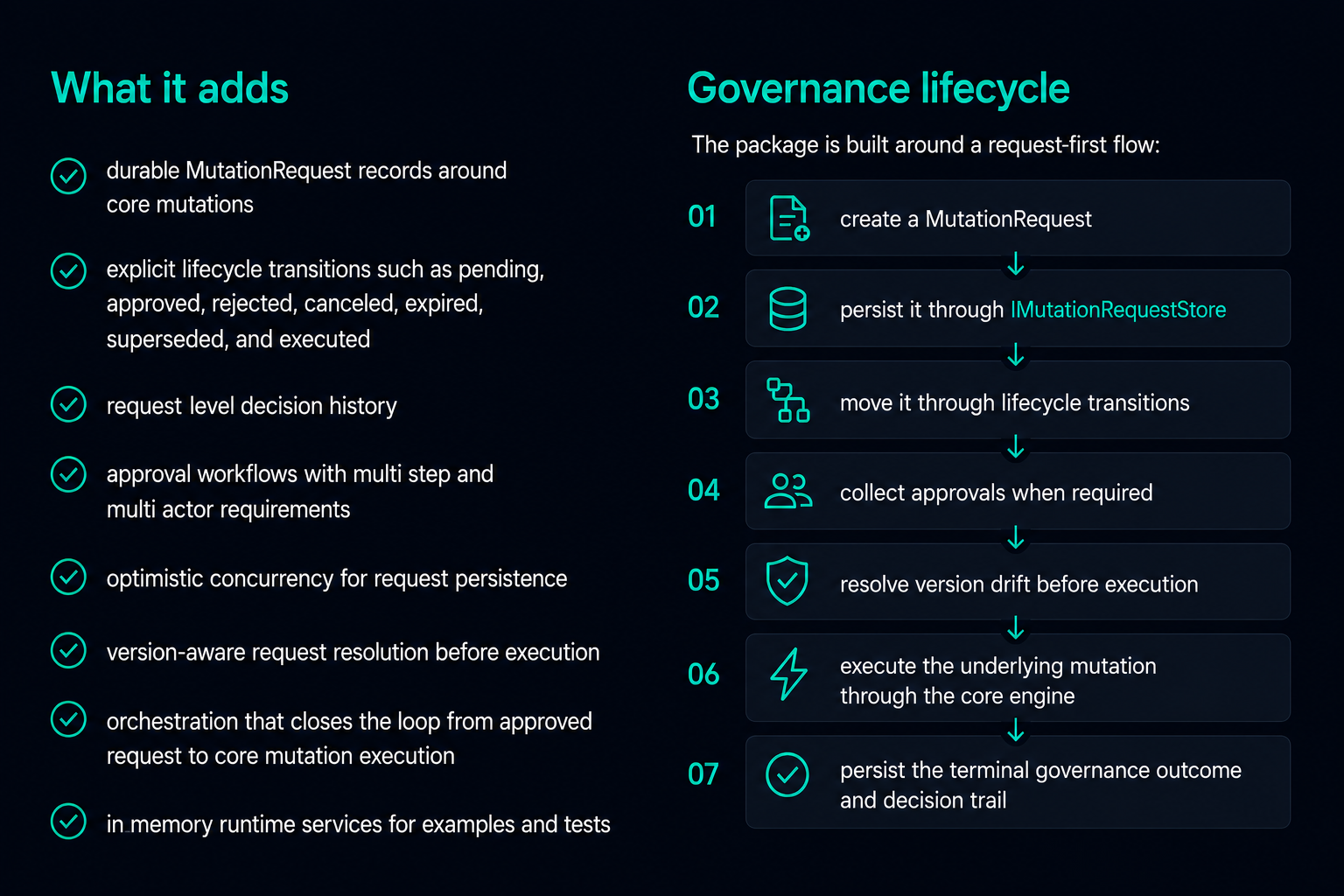
- request modeling and decision history
- approval requirements and workflow execution
- optimistic concurrency in request storage
- version-aware resolution before execution
- governed execution orchestration
- compensation-aware governed execution links and history
- in-memory support for local runtime scenarios
Not included yet:
- production persistence providers such as EF Core or PostgreSQL
- reporting/query stores for operational governance views
- distributed saga-style compensation orchestration
- retry orchestration
- external approval system integrations