Quick start
using Microsoft.Extensions.DependencyInjection;
using ModularityKit.Mutator.Abstractions;
using ModularityKit.Mutator.Abstractions.Changes;
using ModularityKit.Mutator.Abstractions.Context;
using ModularityKit.Mutator.Abstractions.Engine;
using ModularityKit.Mutator.Abstractions.Intent;
using ModularityKit.Mutator.Abstractions.Policies;
using ModularityKit.Mutator.Abstractions.Results;
using ModularityKit.Mutator.Runtime;

var services = new ServiceCollection();
services.AddMutators(MutationEngineOptions.Strict);

var provider = services.BuildServiceProvider();
var engine = provider.GetRequiredService<IMutationEngine>();

engine.RegisterPolicy(new PreventNegativeQuotaPolicy());

var state = new QuotaState("tenant-42", 10);
var mutation = new IncreaseQuotaMutation("tenant-42", 5);

var result = await engine.ExecuteAsync(mutation, state);
Console.WriteLine(result.NewState!.Quota);

public sealed record QuotaState(string StateId, int Quota);

public sealed class IncreaseQuotaMutation : MutationBase<QuotaState>
{
    public IncreaseQuotaMutation(string stateId, int amount)
        : base(
            CreateIntent(
                operationName: "IncreaseQuota",
                category: "Quota",
                description: "Increase tenant quota"),
            MutationContext.System("Initial quota setup") with { StateId = stateId })
    {
        Amount = amount;
    }

    public int Amount { get; }

    public MutationResult<QuotaState> Apply(QuotaState state)
        => MutationResult<QuotaState>.Success(
            state with { Quota = state.Quota + Amount },
            ChangeSet.Single(StateChange.Modified("Quota", state.Quota, state.Quota + Amount)));

    public ValidationResult Validate(QuotaState state)
        => Amount > 0
            ? ValidationResult.Success()
            : ValidationResult.WithError("Amount", "Amount must be positive.");
}

public sealed class PreventNegativeQuotaPolicy : IMutationPolicy<QuotaState>
{
    public string Name => "PreventNegativeQuota";
    public int Priority => 100;
    public string? Description => "Rejects quota changes that would go negative.";

    public PolicyDecision Evaluate(IMutation<QuotaState> mutation, QuotaState state)
        => PolicyDecision.Allow();
}
Execution model
IMutationEngine runs a consistent pipeline around every mutation:
- evaluate registered policies
- validate the mutation against current state
- run interceptors
- apply the mutation
- record audit/history data
- update runtime metrics
Core runtime concurrency is controlled by MutationEngineOptions.MaxConcurrentMutations.
- mutations targeting the same
MutationContext.StateIdare serialized - batch execution remains ordered and sequential
- this is separate from request-storage concurrency in
ModularityKit.Mutator.Governance
Primary APIs
Engine
IMutation<TState>MutationBase<TState>IMutationEngineIMutationExecutorMutationEngineOptions
Policies
IMutationPolicy<TState>IPolicyRegistryPolicyDecisionPolicyRequirementPolicyCompositionPolicyCompositionMode
Async policies and external checks
IMutationPolicy<TState> supports both synchronous and asynchronous evaluation.
- implement
Evaluate(...)for lightweight in-process rules - implement
EvaluateAsync(..., CancellationToken)for external identity, ticketing, quota, or compliance checks - the runtime evaluates policies in descending
Priorityorder - sync and async policies can be registered together; they participate in the same priority-ordered pipeline
- when
MutationEngineOptions.PolicyEvaluationTimeoutis set, the timeout is applied per policy evaluation - caller cancellation still flows through unchanged
- policy failures are surfaced as
PolicyEvaluationException - policy timeouts are surfaced as
PolicyEvaluationTimeoutException
Typical integration cases include:
- external approval evidence checks
- actor/identity resolution against IAM or directory systems
- ticket status validation before execution
- quota lookups in remote control planes
- compliance or risk verification before commit
When policies need to be reused as a set, PolicyComposition.AllOf(...),
PolicyComposition.AnyOf(...), and PolicyComposition.Priority(...) provide a deterministic
way to combine decisions without adding a separate rules language.
Merge rules are explicit:
- severity uses the highest severity from the selected policy branch
- requirements are preserved and concatenated
- side effects are concatenated
- metadata merges by key and raises
PolicyCompositionConflictExceptionwhen two policies try to set the same key to different values - state and other mutation-result modifications follow the same conflict rule
public sealed class RequireApprovedTicketPolicy : IMutationPolicy<QuotaState>
{
    private readonly ITicketGateway _tickets;

    public RequireApprovedTicketPolicy(ITicketGateway tickets)
    {
        _tickets = tickets;
    }

    public string Name => "RequireApprovedTicket";
    public int Priority => 200;
    public string? Description => "Checks ticket approval status before quota changes execute.";

    public async Task<PolicyDecision> EvaluateAsync(
        IMutation<QuotaState> mutation,
        QuotaState state,
        CancellationToken cancellationToken = default)
    {
        var ticketId = mutation.Context.CorrelationId;
        var approved = await _tickets.IsApprovedAsync(ticketId!, cancellationToken);

        return approved
            ? PolicyDecision.Allow(Name, "External ticket is approved.")
            : PolicyDecision.Deny("External ticket is not approved.", Name);
    }
}
Results and changes
MutationResult<TState>BatchMutationResult<TState>ValidationResultChangeSetStateChangeSideEffectSideEffectDataContractAttributeSideEffectDataContractRegistry
Typed side effects
Use typed side effect payloads when the emitted data is meant to survive serialization, audit, or downstream integration:
[SideEffectDataContract("workflow.started", 1)]
public sealed record WorkflowStartedSideEffectData
{
    public required string Initiator { get; init; }
    public required int StepCount { get; init; }
    public required string WorkflowId { get; init; }
}

SideEffectDataContractRegistry.Register<WorkflowStartedSideEffectData>();

var effect = SideEffect.Create(
    type: "WorkflowStarted",
    description: "Approval workflow started",
    data: new WorkflowStartedSideEffectData
    {
        Initiator = "alice",
        StepCount = 2,
        WorkflowId = "wf-42"
    });
The side effect keeps DataContractType and DataContractVersion alongside Data, so persistence and integration layers do not have to guess the payload shape.
Context and intent
MutationContextMutationIntentBlastRadius
Runtime observability
IMutationAuditorIMutationHistoryStoreMutationHistoryIMetricsCollectorMutationStatisticsIMutationInterceptor
Examples
Runnable examples for the core engine live under Examples/Core:
Relationship to governance
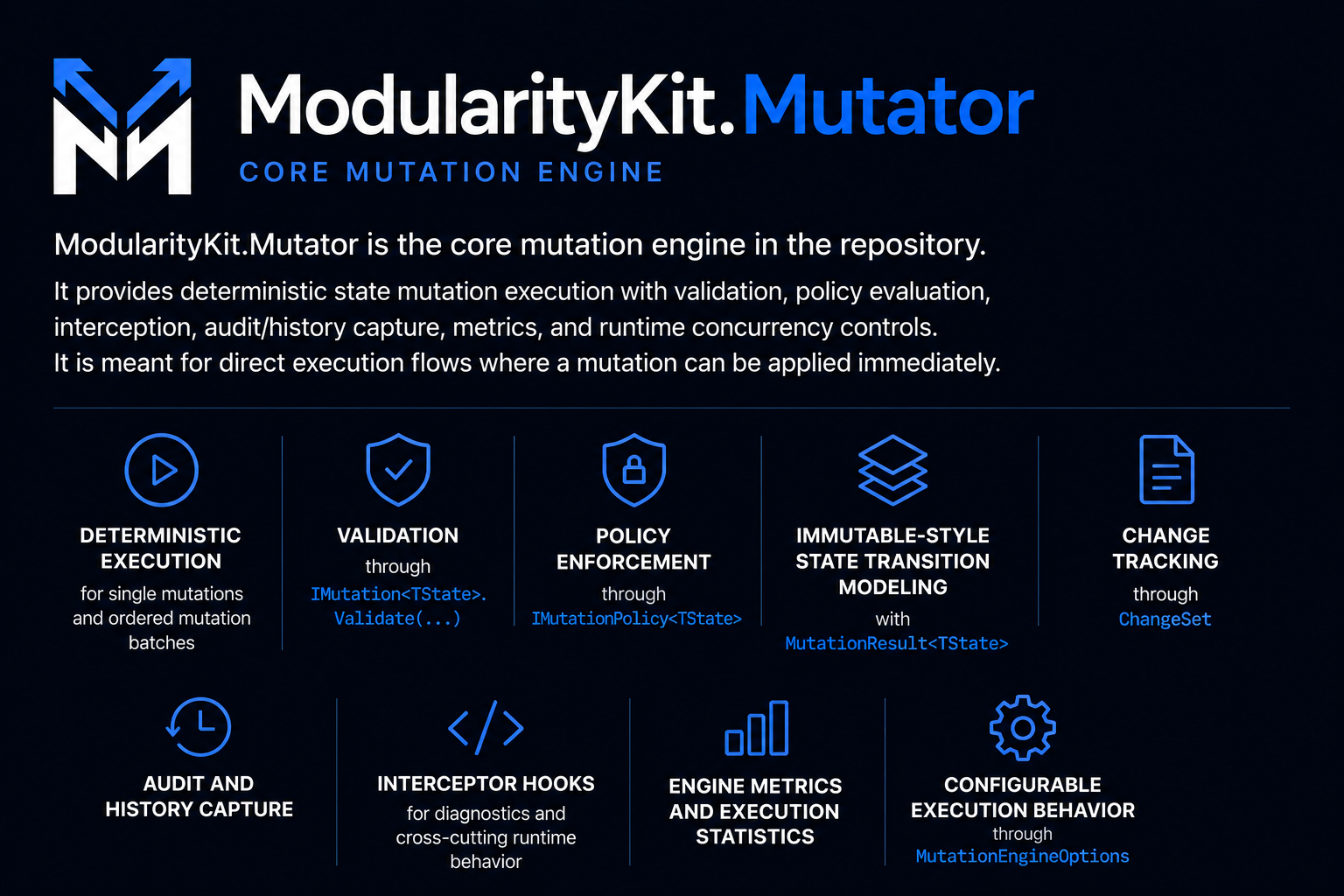
ModularityKit.Mutator is the direct execution runtime.
If your workflow needs deferred execution, request approval, pending states, or stale-version resolution before the mutation can run, use ModularityKit.Mutator.Governance on top of the core package.
Current scope
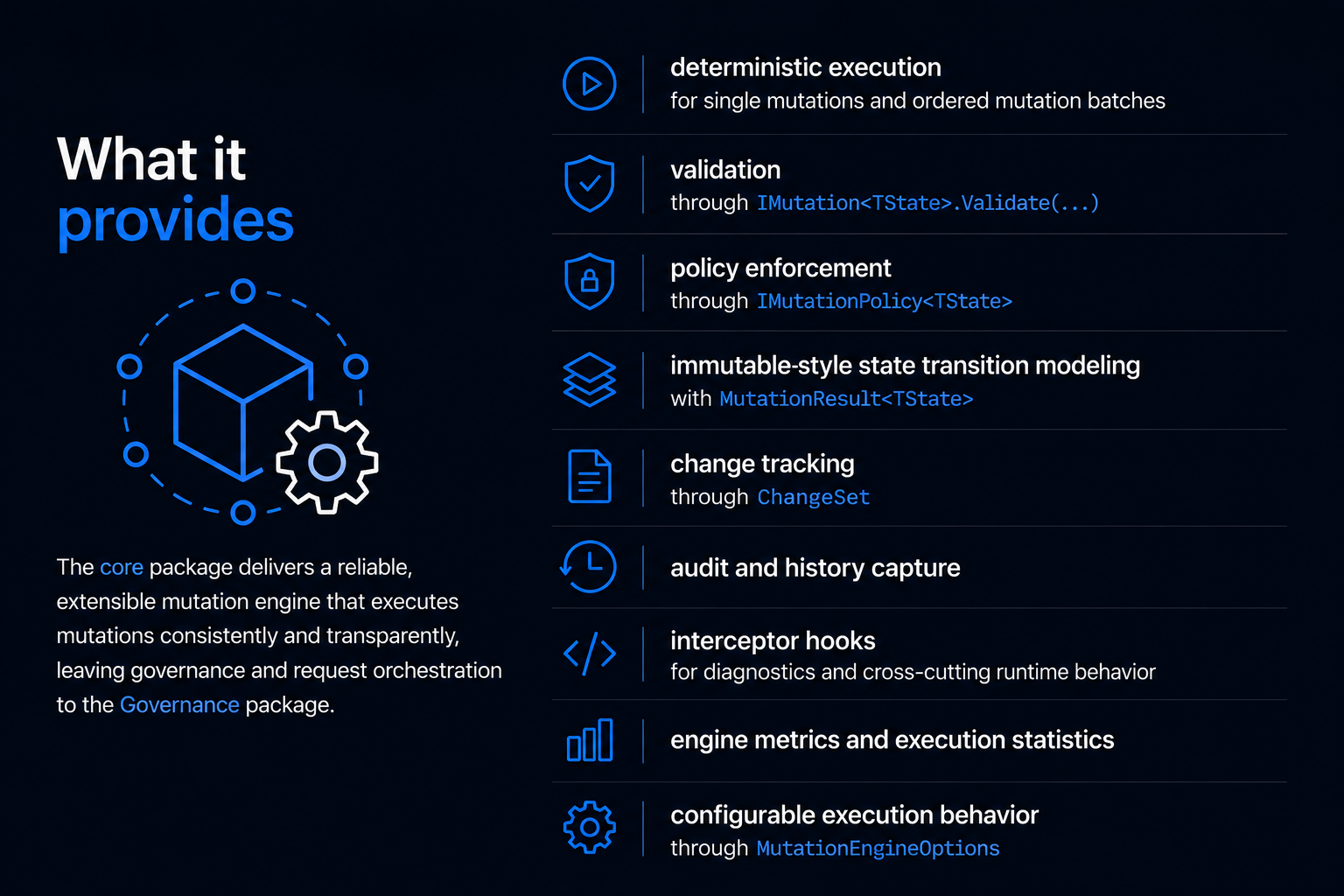
Included today:
- direct mutation execution
- batch execution
- policy evaluation
- validation and failure modeling
- audit/history capture
- metrics and interception
- in-memory runtime components for local and test scenarios
Not included in the core package:
- request lifecycle management
- approval workflow orchestration
- versioned request resolution
- governed request persistence contracts